
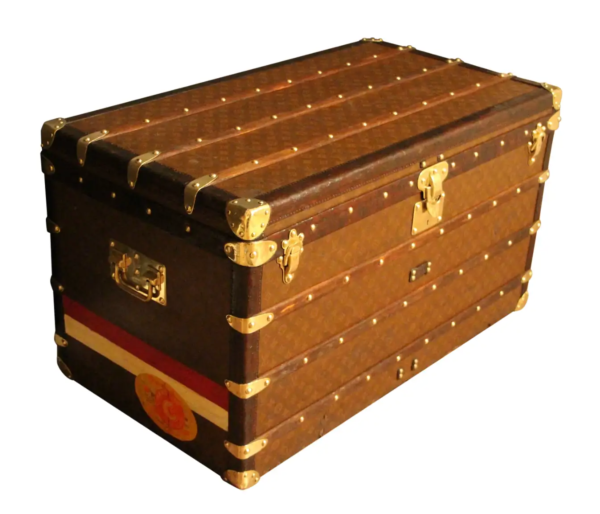
Louis Vuitton: From simple packer to creator of the famous trunk.
a brief history of packaging
You must be familiar with the Louis Vuitton trunk.
But did you know that the history of the Vuitton family's entrepreneurial saga began in the 19th century in a rapidly changing world?
"Luxury must be comfortable, otherwise it is not luxury"
Louis Vuitton
Short biography of Louis Vuitton
Louis Vuitton was born in 1837 in the Jura region. He was 16 when he arrived in Paris to apprentice with Monsieur Maréchal.
Louis Vuitton began his career as a packer-cratemaker, a discipline for which he was particularly gifted. At a time when luggage was subjected to harsh conditions during transport, having a talent in this field was very promising. And it turned out that Louis Vuitton was skilled in making crates and trunks.
The Vuitton adventure was launched. Bolstered by this experience and after 17 years of service with Monsieur Maréchal, the first Maison Vuitton opened its doors in 1854, at 4, rue de Neuve-des-Capucines in Paris.
Louis Vuitton remained faithful to his expertise and offered wooden crates, trunks, and travel items. From the outset, Louis Vuitton positioned himself on high-end items. Four main players shared this booming market: Hermès, Goyard, Moynat, and Vuitton. They were also the first to sign their luggage, a sign of their excellence. The other market players appeared as more modest providers.
The Louis Vuitton trunk
The so-called Louis Vuitton trunk is world-renowned. All the genius of Louis Vuitton and his son Georges lies in the innovations they developed to revolutionize the making of a travel trunk.
By extension, they revolutionized, or even created, the art of travel.
Innovation 1: The shape of the trunk
In the 19th century, people traveled with all their personal belongings. This was tedious, bulky, and as we have seen, objects were subjected to harsh conditions.
All trunks of that era had domed lids. This made storing them particularly difficult. The lids were domed in both directions to allow rain to run off properly. This shape also enhanced their solidity.
Louis Vuitton and his son Georges, aided by a particularly efficient workshop composed of 20, then 100, and finally 225 workers in 1914, decided to make the lid flat.
This workshop still exists, located in Asnières, a suburb of Paris.
The trunks are handmade, using high-quality materials such as leather, wood, and brass.
The trunks could then be stacked one on top of the other.
From the start, Louis Vuitton positioned itself as a luxury product, like Moynat, Goyard, and Hermès.
They were the only ones to sign their creations with a dedicated label and a logo. If you own a trunk and it doesn't have a label with one of these four names, you can be sure it doesn't come from one of these prestigious houses.
The floral motif created by Georges became the symbol of the Vuitton house. It quickly appeared and covered most of the brand's products.

Domed lid travel trunk

Louis Vuitton travel trunk
The flat lid of the trunks allowed for better stacking of luggage in the back of horse-drawn carriages.
Innovation 2: An ultra-resistant lock.
Louis Vuitton also evolved all the components of a travel trunk.
Thus, he thoroughly redesigned the lock system, adopting a lever lock. Instead of the traditional leather-encased locks, father and son preferred to affix a central lever lock and two locks on either side.

Thanks to @malle2luxe for this diagram


With these two innovations, Louis Vuitton perfectly embodied why he had created his own store: the alliance of elegance and functionality.
Louis Vuitton travel trunks have become collector's items in their own right. They come in all sorts of varieties.
Some antique dealers at the Puces de Paris Saint-Ouen have specialized in them, such as Elisio Das-Neves with his shop in the Serpette market, as these two photos show.
At that time, there were many workshops that made travel trunks or wooden crates.
But only Vuitton, Goyard, and Moynat focused on crafting luxury products. Both aesthetic, lightweight, and innovative, these products became true symbols of social status and elegance.
A packaging specialist is called a "layetier-emballeur" (cratemaker-packer)
What is the profession of "layetier-emballeur"?
As we saw previously, Louis Vuitton worked for Mr. Maréchal for 17 years as a cratemaker-packer.
But what is the cratemaker's trade?
It is defined as follows: a maker of layettes (boxes for clothes), wooden crates, and various packaging.
The term "layetier" has existed since 1582.
Quickly, the terms "layetier" and "emballeur" were associated to define the same profession.
The two skills are combined to pack objects, pack works of art. In general, the packer takes measurements while the cratemaker builds the wooden packaging crate.

19th century cratemaker drawing
With the development of travel, the packing profession was in vogue at the end of the 19th century.
But what are the qualities of a good packer?
Qualities of a good packer
According to the definition in the Dictionnaire raisonné universel des arts et métiers published in 1773, a good packer is defined by several points.
- Arrange goods so that there is no empty space between them.
- Goods do not rub against each other.
- Separate fragile goods from heavier ones.
- Ensure proper sealing of boxes.
- Unload if possible once shipped.

You need to go to p. 329 to discover a few words about this profession, which consisted of assembling wooden planks to create packaging.

By creating our packing station at the heart of the Saint-Ouen Flea Market, we are becoming part of the history of this little-known profession.
A packing station at the heart
of the Puces de Paris-Saint-Ouen
It is therefore in the purest tradition of crafts that we created, 5 years ago, a packing station at the heart of the world's most famous flea market, Les Puces de Paris Saint-Ouen.
The creation of this place, entirely dedicated to art packaging, where you can find cardboard boxes, tape, and our custom packaging service, makes sense in the history of our company.
The bubble wrap pouch for framed paintings
Indeed, La Bulle takes its name from the creation of the famous bubble pouch in the 1980s. The bubble pouch particularly revolutionized the art of packing paintings. Extremely easy to use,
Today we have about twenty references. From the small 15x25 sachet to the large 1.68x1.68 cm pouch!
Today we have about twenty references. From the small 15x25 sachet to the large 1.68x1.68 cm pouch!
Go right there to discover the advantages of the bubble pouch with the possibility to buy it online.
I discover the bubble pouch
A custom art packaging service
for galleries and museums

Here is an example of one of our wooden crate creations for a work of art at Les Puces de Paris Saint-Ouen.
Always listening to our clients, we quickly expanded the service offerings of our packing station.
As a result, more and more merchants asked us to do their art packaging. Indeed, many of them had had bad experiences with their packaging, and items arrived broken at the recipient's.
We therefore developed a custom packaging service to offer our clients a complete art packaging solution.
Our packaging formulas
1- The take-away formula
Come visit us at the packing station at 28 bis rue Paul Bert in the heart of the Puces de Paris Saint-Ouen.
Choose your boxes, your bubble pouches and/or your foam corners, and leave to create your own packaging. To help you, we have written a blog article dedicated to the 5 essentials for quality packaging.
2- The custom formula.
Come to the packing station.
We will work together to determine the most suitable packaging for your needs and create your art packaging on-site.
For simple cardboard packaging, this can be done the same day, but for the creation of wooden crates in the purest tradition of cratemakers, we will need a few days.
See La Bulle packing station
Find us in
the Louis Vuitton City Guide
the Louis Vuitton City Guide
La Bulle
23 bis rue Paul Bert
93400 Saint-Ouen
Packing Station
28 bis rue Paul Bert
93400 Saint-Ouen
23 bis rue Paul Bert
93400 Saint-Ouen
Packing Station
28 bis rue Paul Bert
93400 Saint-Ouen
Information, quote request
contact@labulle-paris.com

Art Packaging - The 5 Essentials
How to pack a painting for a move or after a sale? Paintings, frames, canvases… how to pack them safely before transport or sale?...
Nov 30 2021