
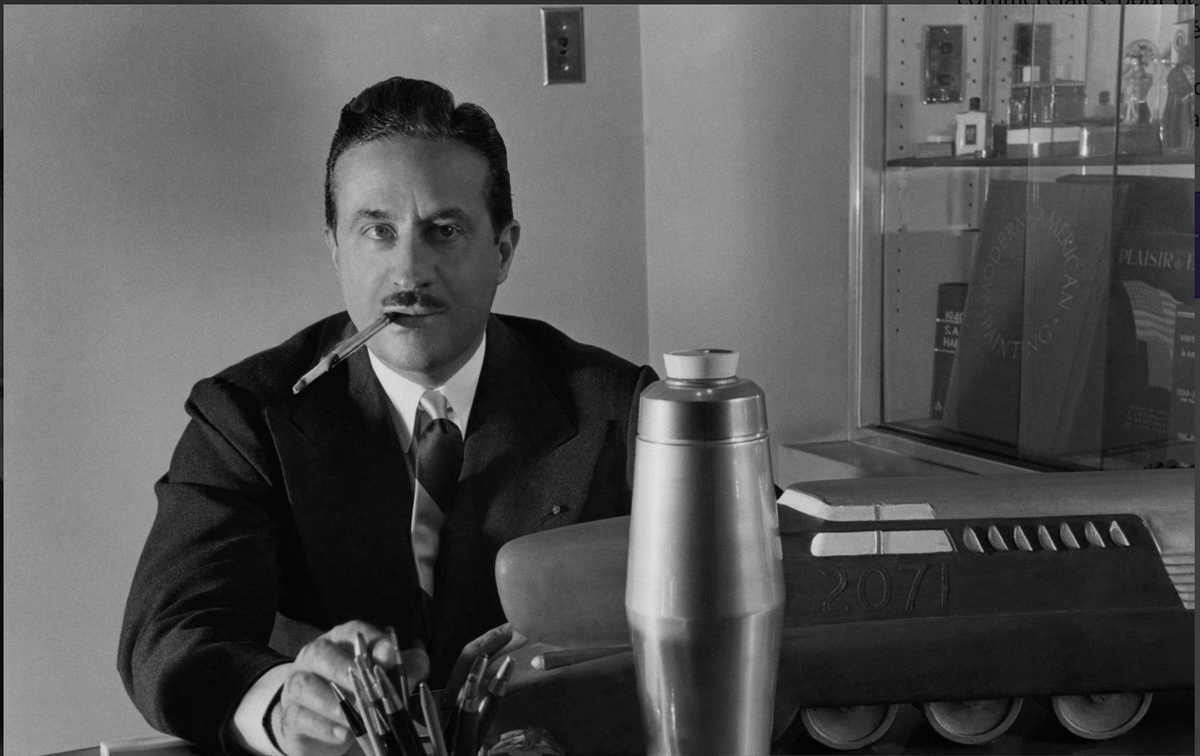
Raymond Loewy: the pioneer of industrial design
|
|
Time to read 5 min
|
|
Time to read 5 min
Ugliness sells poorly
At La Bulle, we draw inspiration from personalities in the world of arts, fashion, and design. As evidenced by the article we wrote about Kishizo Inagaki, Rodin's plinther
Raymond Loewy is one of those inspiring personalities.
A pioneer of industrial design, known for having shaped a unique and recognizable style. Raymond Loewy brought design into American homes by, for example, creating the design of the Coca-Cola bottle.
Raymond Loewy is considered the father of modern and industrial design.
Born in France on November 5, 1893, in Paris. He made his career in the United States, leaving an indelible mark on the world of design.
After doing his part in the First World War, Raymond Loewy joined his brother in the United States in 1919.
A very talented draftsman, he was recruited as an illustrator for fashion magazines such as Vogue and Harper's Bazaar.
Gradually, his thinking on design took shape, and he quickly made an observation that stayed with him throughout his career.
We are surrounded by ugly things, why not make them beautiful and aesthetic?
From that moment on, he continuously worked to make everyday objects more beautiful while remaining functional.
Raymond Loewy worked 6 months of the year in the United States and spent the rest of his time traveling all over the world to find inspiration. Travels, encounters, gastronomy nourished his imagination.
In 1930, he opened his own design agency and signed his first contracts. He always pursued the same goal.
To create objects that are both aesthetic and technological
His areas of expertise were not limited to objects. It can be said that he revolutionized the way people consume, riding the wave of early marketing. Brands needed to modernize, to enter a new era. Raymond Loewy was there for that.
With the crisis of 1929, industrialists quickly understood that to attract new customers and avoid going out of business, they would have to generate desire and make an impression. Design penetrated thousands of homes through their refrigerators, their Coca-Cola bottles, their Lucky Strike cigarette packs. What did these objects have in common? They were all designed by Raymond Loewy and his teams.
In 1971, Shell decided to change its logo. To do so, they called on Raymond Loewy.
For this logo, Raymond Loewy drastically simplified the design of the seashell. The strength of this design is that it does not alter the brand's historical emblem in any way. The seashell.
The yellow and red colors were kept, while the crenelated edges were removed, and the shell's ridges were reduced from 13 to 7. The typography used is Futura Bold.
Even today, we all remember this 1970s logo, because:
it is modern, impactful, and simple.
There are many such examples, as Raymond Loewy has, in a way, shaped minds through his designs.
Raymond Loewy's agency is involved in both logo creation and the production of industrial products. From designing locomotives to refrigerators.
By the turn of the 1960s, Raymond Loewy's reputation was well-established, and his projects became increasingly prestigious.
By imagining the interior architecture and colors of a special Boeing 707 for President Kennedy and his Air Force One, Raymond Loewy contributed to conveying a modern and active image of the Kennedy administration.
Raymond Loewy arrived in the United States at a time when the myth of the American dream was still a reality for many migrants. Landing on American shores meant landing in a world completely unknown to Europeans. Modernity was everywhere, with an unlimited thirst for entrepreneurship.
Raymond Loewy was part of this adventure, even though it took him ten years to make a name for himself.
It must be said that at the time, the profession of designer did not exist. Shaping and imagining objects did not interest many people. Raymond Loewy himself did not yet imagine the career that awaited him as an object designer.
Raymond Loewy can be considered part of the design movement called Streamline or "Paquebot" style.
This design movement emerged in the United States in the 1930s.
Its goal? To create objects whose forms and lines are directly inspired by industrial constructions. Objects are more ergonomic but also more attractive. Their streamlined shape simulates the speed of locomotives or race cars.
The Streamline style is found in architecture and the creation of everyday objects.
Objects in motion, even when stationary, for a society in full transformation.
The strength of Streamline design: an alliance between aesthetics and technology. Raymond Loewy never prioritized design over technology. Today, Raymond Loewy is a creator little known to the general public. Which did not prevent him from making the cover of Time magazine in 1931.
Raymond Loewy represents an era that now seems carefree and bygone. He is the symbol of the "American way of life". He was a true visionary who, at the beginning of the 20th century, placed design and the beauty of objects at the heart of marketing concerns.
It is in this spirit, both technological and aesthetic, that we have created for you and exclusively
the display stand for Coco de Mer.
Its design is simple and sleek. Why only one color choice, black?
Black is a sober and elegant color that pairs well with most Coco de Mer colors.
Did you know? The coco de mer, also called coco fesse, is a seed. It is the national emblem of Seychelles.
This seed only grows there. Its purchase and repatriation are extremely regulated.
Take a look at how
we adjust the stand to the seed
Raymond Loewy was a visionary. A man who dedicated his life to design and the creation of objects. Not being an engineer, he designed objects whose technique and efficiency were already proven. He provided the aesthetic touch that the object needed to sell well. Today, his legacy is still present in many everyday objects, and industrial design owes him a great deal.


