
The history of the Russian Imperial Fabergé eggs.
You are surely familiar with the Fabergé egg. This work of art inhabits the collective imagination of art enthusiasts, but do you know its history?
The Fabergé egg "The perfect marriage of art and technique"
A brief history of the Fabergé egg.
It all began in 1842 in Saint Petersburg with the creation of the Fabergé House by Pierre-Karl Fabergé's father.
After his training with the greatest jewelers in Europe, which took him all over the continent, Pierre Karl took over the family business in 1872. Thanks to his training and his work, the House of Fabergé was quickly noticed by the most influential figures, first and foremost Tsar Alexander III.
Significance of the gold and enamel Fabergé eggs:
a gift like no other
It was at the request of Tsar Alexander III that Pierre-Karl Fabergé began creating these famous enamel and gold eggs in 1885.
The Tsar wished to give his wife, Maria Fedorovna, an Easter egg to celebrate the twentieth anniversary of their engagement.
It is believed that the Tsar got the idea from a decorated egg owned by his wife's aunt. This object had fascinated Maria Fedorovna throughout her childhood.
What did this first Fabergé egg look like?
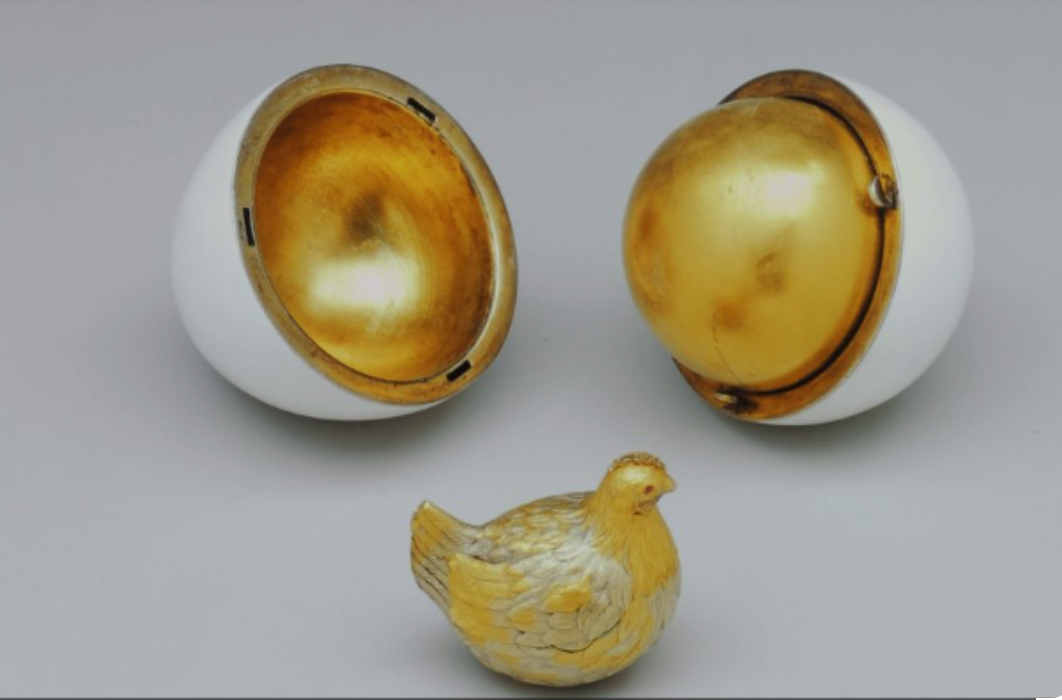
This egg is made of gold, its white enameled shell opens to reveal the yolk of the egg, itself in matte gold, from which a hen emerges. Hence its name, the Hen Egg.
The golden hen also opens, containing a diamond replica of the Imperial Crown from which a small ribbon with a ruby pendant was suspended. Unfortunately, these two elements have disappeared.
The success of this exceptional object was immediate; the Empress was captivated.
Alexander III therefore named Fabergé "goldsmith by special appointment to the court."
This egg was the first in a long series that would make the House of Fabergé famous, as the Tsar would order one each year.
Significance of the gold and enamel Fabergé eggs:
a gift like no other
The Hen Egg

The golden age of the Fabergé egg
From 1885 to 1917, no less than 50 eggs of this type were created for Tsars Alexander III and Nicholas II.
Each egg is unique and ingeniously decorated.
Fabergé eggs are made from noble materials such as gold, precious stones, and colored enamels.
The different themes and symbolism of Fabergé eggs
Fabergé eggs can be placed into two categories: those originating from a request by Tsar Alexander III and those by his son Nicholas II. The latter ordered Fabergé eggs for both his wife and his mother, the dowager empress.
Whether for one or the other, the House of Fabergé created eggs of unparalleled quality.
The jeweler was inspired by family events, nature, or the lifestyle of these two families.
Diamond Trellis Egg

Here is "The Diamond Trellis Egg," a work of art given by Tsar Alexander III to his wife. It is covered with a diamond trellis. This egg opens to reveal a diamond elephant that has unfortunately disappeared.
Today, this collector's item belongs to a private collector and is preserved at the Houston Museum of Natural Science.
Alexander III Equestrian Egg


This creation dates from 1909 and was commissioned by Nicholas II for his mother, the Dowager Empress Maria Fedorovna.
This Fabergé egg depicts Tsar Alexander III on his mount. A small statue directly inspired by the "Peacemaker Tsar."
The equestrian statue is gilded and rests on a lapis lazuli base, the casing is made of rock crystal, and the mounting is platinum decorated with two-headed eagles and a diamond-incrusted grid.
Bay Tree Egg

This egg is also one of Nicholas II's gifts to his mother. Created in 1911, and like every Fabergé egg, this one contains something exceptional. A mechanical bird emerges from the top of the shrub.
The bird sings when one of the tree's fruits is manipulated.
Red Cross Egg

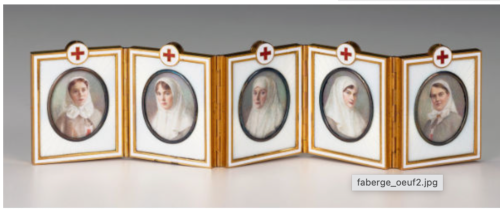
This egg pays tribute to the commitment of Nicholas II's mother, the empress, as president of the Russian Red Cross during the First World War.
The inside of the shell contains 5 portraits of women dressed as Sisters of Mercy.
These are the empress's daughter-in-law, her two elder daughters, and two close friends.
Coronation Egg


Created in 1897 and then offered to Empress Maria Fedorovna in honor of her coronation, this Fabergé egg is of exceptional beauty.
Entirely made of gold, the shell is covered with a translucent yellow-green enamel that refers to the color of the Empress's dress on the day of her coronation. The trellis of the shell is composed of laurel leaves intertwined with imperial eagles.
The highlight of the show, upon opening the shell, is the discovery of a replica of the carriage that took the Tsarina to the Dormition Cathedral in Moscow.
This Fabergé egg is certainly the most accomplished.
Trans-Siberian Egg

This egg marks a very important event for Russia in the 1900s. A gift for Easter, it celebrates the completion of the construction of a section of the Trans-Siberian railway.
Its composition is remarkable.
The foldable train nestles inside the egg, which is entirely covered in velvet.
The train's headlights are made of rubies, while the windows of the carriages are made of rock crystal.
On one of its sides is traced the route already traveled and yet to come of the Trans-Siberian.
It is one of the rare Fabergé eggs that has never left Russia.
Ultimately, what is a Fabergé egg?
How to recognize a Fabergé egg?
It's important to know that there are about fifty of them, each more magnificent than the last. We could offer this definition: a piece of goldsmith's work made under the direction of the Russian jeweler Pierre Karl Fabergé for the Russian imperial family.
This collection consists of the so-called Fabergé eggs.
In 1917, with the Russian Revolution, the production of Fabergé eggs ceased and Pierre Karl was forced to flee to Switzerland.
The collection was confiscated, sold, and dispersed across the world.
Today, most of the eggs are found in museums in Saint Petersburg, the Kremlin, and Moscow.
Others have disappeared, further fueling the mystery and fascination surrounding these exceptional works of art.
Impact of Fabergé eggs on art and culture
Even today, and if one has the means, Fabergé eggs can be acquired through auctions. The famous auction house Christie's organizes sales of Fabergé eggs. In 2007 and 2017, egg sales reached record sums.
This type of event arouses public curiosity and creates an imaginary world around these objects.
A fever even grips collectors hoping to find a forgotten Fabergé egg at a flea market.
The aesthetic impact is also undeniable, as the quality and refinement of the productions stir the desire of copyists.
If you wish to admire Fabergé eggs, you must visit the Fabergé Museum in Baden-Baden. The last known exhibition dates from 2021.
You might like on
the La Bulle blog

Read the article
Discover the history of the Louis Vuitton trunk, known and recognized worldwide.
La Bulle expert in art presentation and packaging
Tags:
Previous post
The history of the Olympic medal
Next post
Representing Christ: the articulated Christ example

How to find good deals at the Saint-Ouen Flea Market?
Finding an exceptional piece in the aisles of a flea market or at Les Puces de Saint-Ouen, the story is beautiful, but it's not...
Mar 17 2026

Representing Christ: the articulated Christ example
Do you know the articulated Christ? It all started with this photo sent by a friend, with this message: "Have you seen the beauty...
Sep 29 2025

The history of the Olympic medal
The Paris 2024 Olympic and Paralympic Games are overExtend the fun by discovering the history of the Olympic medal? La Bulle, art presentation expert,...
May 27 2024

How to base a coconut butt?
How to present a coco de mer? Discover our custom-made bases for this extraordinary object Lovers of this emblematic Seychellois seed, we have created...
May 15 2023
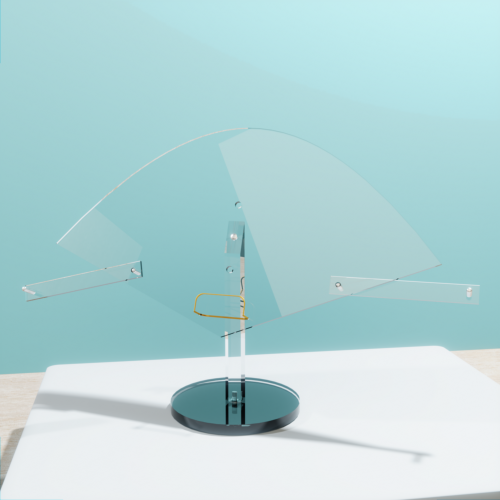
Present a fan
Enhance your fans with our custom displays or bases In this article, we won't explain how to make a fan, but rather how to...
Dec 13 2022
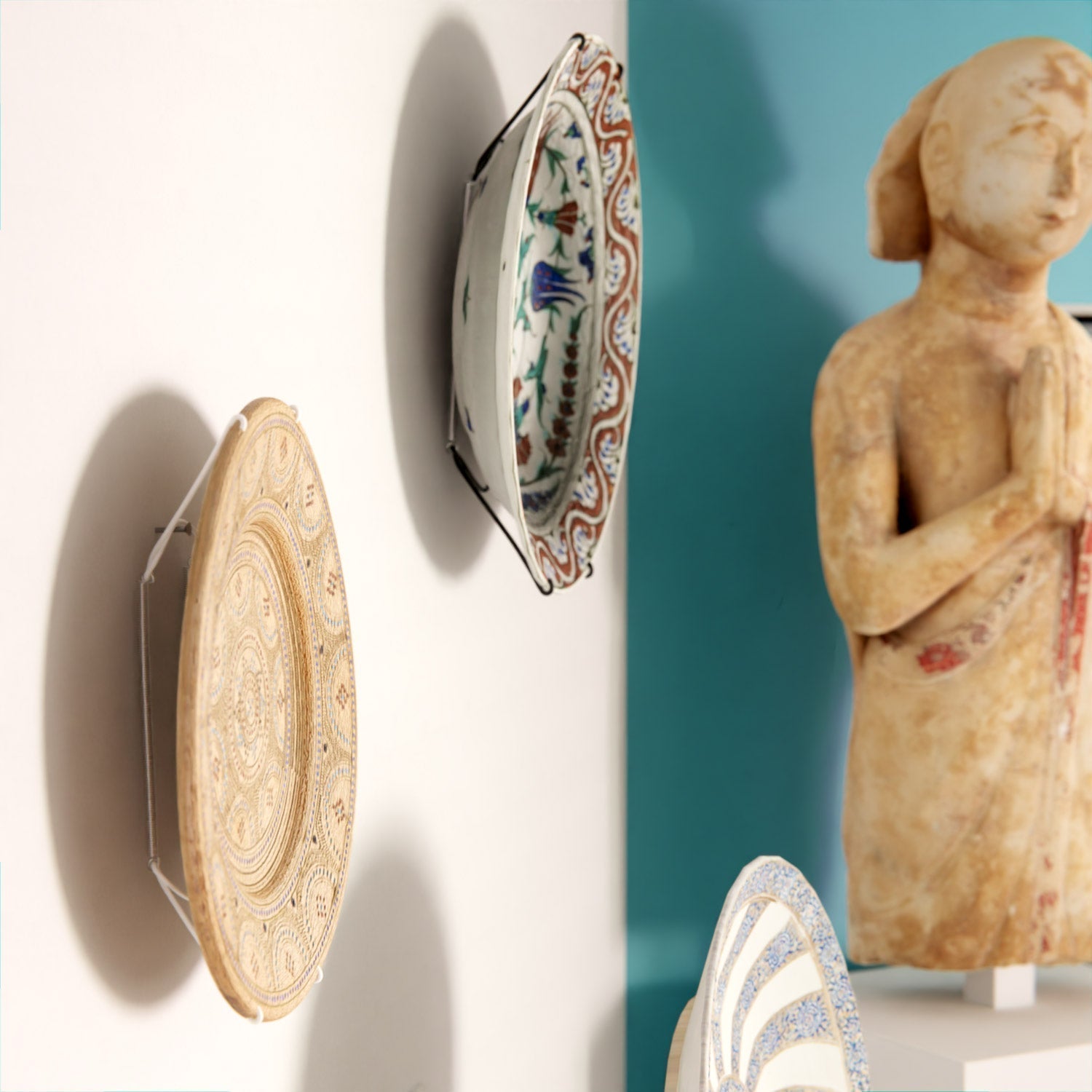
Your decorative plates
Decorative Plates: When Tableware Becomes a Display Piece Large, small, to hang on the wall or simply display, decorative plates add an original and...
Sep 30 2022

Wood's lamp: The many benefits of this ultra-powerful UV lamp
Ultra-powerful UV Wood's Lamp: principle, operation, and uses The world around you is full of hidden things. Things that are concealed in your environment...
Sep 08 2022