

How to display a painting? A complete guide for optimal presentation
A brief history of displaying paintings
Have you ever wondered why a painting was displayed in a certain way? Why at that height, why on that wall?
Before you and I, others established scenography rules that answer this question.
Welcome to the Royal Academy of Painting and Sculpture. Created in 1648 by the artist Charles Le Brun. The Royal Academy's mission is to train painters and sculptors to spread academic art through their discipline. In addition to this educational vocation, the Academy also aims to educate the public's eye to beauty. Academic beauty. The practice of painting and sculpture is codified, leaving little room for fantasy.
Exhibiting paintings at the Salon
To showcase the work of its students, the Academy decided, starting in 1667, to organize public exhibitions free of charge. They are called Salons, ever since these exhibitions of paintings and sculptures have been held in the Salon Carré of the Louvre.

Crowds flocked to the Salon, as this illustration shows.
But doesn't anything surprise you?
Does anything shock you in this image? Look closely.
The paintings, how are they hung?
We can clearly see that they are one above the other. But don't imagine that this was done randomly. Quite the contrary. This way of exhibiting works in the 18th century corresponds to what was then called
the hierarchy of genres
The hierarchy of genres in painting
The Royal Academy of Painting and Sculpture was an authoritative institution in the field of arts.
This authority was even manifested in the way it hung paintings at the Salon. Thus, a very precise order, known as the hierarchy of genres, had to be respected. Classical painting therefore categorized paintings by order of importance.
- History painting: This includes subjects drawn from fables or history. Three subjects stood out: religious painting, mythological painting, or battle narratives. These paintings were placed at the very top.
- Portraiture: Its purpose was to glorify a prominent figure of the time. Usually placed in the middle, at eye level.
- Genre scene: Scenes of an anecdotal or familiar nature. A subcategory of history painting, it reached its peak between the mid-19th century and the 1930s in Northern Europe.
- Landscape: Also includes animal portraits and seascapes. The latter held a prominent place due to the technical difficulties of representation.
- Still life: Flowers, fruits, game, and any other inanimate objects. Placed at the very bottom.

And concretely, as this painting of a Louvre gallery shows, this is manifested by the installation of history paintings at the top of the room, then portraits, and so on downwards.
The hierarchy of genres is then read on the wall.
💡 Did you know?
The Salon was one of the only places to invite all people, regardless of social class.
Modernizing the display of paintings
The hierarchy of genres in painting lasted until the French Revolution. It was at this time that the influence of the Royal Academy of Painting waned, giving way in 1816 to the Academy of Fine Arts.
The latter was still steeped in classical academic precepts, with the dominance of history painting still prevalent. It was not until the 19th century and the creation of the Barbizon School and then the Impressionists that the trend began to reverse. Landscape painting became the main subject of experimentation.
By the 20th century, all this was ancient history, and a wind of freedom blew over artistic practices.


And here is the Salon Carré of the Louvre in 1909, 1949 and in the 2000s. The walls become lighter over time.
The presentation of the paintings reflects the prevailing modernity.
And how do you display your paintings?
Our interior designer tips for displaying a painting
Do you want to display your paintings but don't know how to go about it?
Choosing the position of a painting in your home can seem tedious, so here are our tips for displaying your paintings.
- The 152 cm rule: Position your painting approximately 152cm from the floor. Your gaze will then be instantly drawn to your painting.
- The 2/3 rule: If you decide to position your painting above a piece of furniture or a sofa, make sure it is 2/3 of its width. This proportion guarantees harmony between the objects. The painting should also be positioned approximately 20/25cm from the furniture in question.
- The "wall gallery": You know, this way of presenting several paintings of different sizes on a wall, somewhat like New York lofts. If you have a small wall, don't hesitate to fill the space with your paintings. If, on the other hand, you have a lot of space, position your paintings quite far apart.
- Lighting: It should never be neglected to ensure a perfect enhancement of your painting(s).
Quick recap in images


Photo credit AD decoration
La Bulle, presentation specialist: present your paintings differently
Are you looking for a different interior decoration or simply don't have enough wall space?
At La Bulle, discover our alternative to hanging paintings on the wall.
For several years, we have been working with Maison Sennelier to produce easels. These easels allow you to display your paintings on a dresser or table. They are also perfect for a gallery presentation with suitable lighting.
Wooden display stands for displaying a painting on a dresser
Here's an elegant and sturdy alternative for displaying your paintings on a table or dresser.
The advantages of "off-the-wall" presentation:
- No more marks on the walls from paintings
- You can change paintings regularly
- You can display on both walls and dressers
- Ideal for art galleries. Clients can easily see the details of the painting.
An art presentation specialist at Les Puces de Saint-Ouen
At La Bulle, we are art presentation specialists.
We offer a range of services entirely dedicated to displaying your artworks or objects.
Our online shop offers several ranges of display stands, from standard to semi-custom.
Our standard display stands in plexiglass or steel
Our semi-custom display stands (we adjust them for you before shipping)

The Fontainebleau Gogottes: History of a Natural Work of Art

Creation of custom plinths for the "Le Dernier Sacre" exhibition at the Galerie des Gobelins
Foundation of contemporary art

Wood for your custom bases and packaging
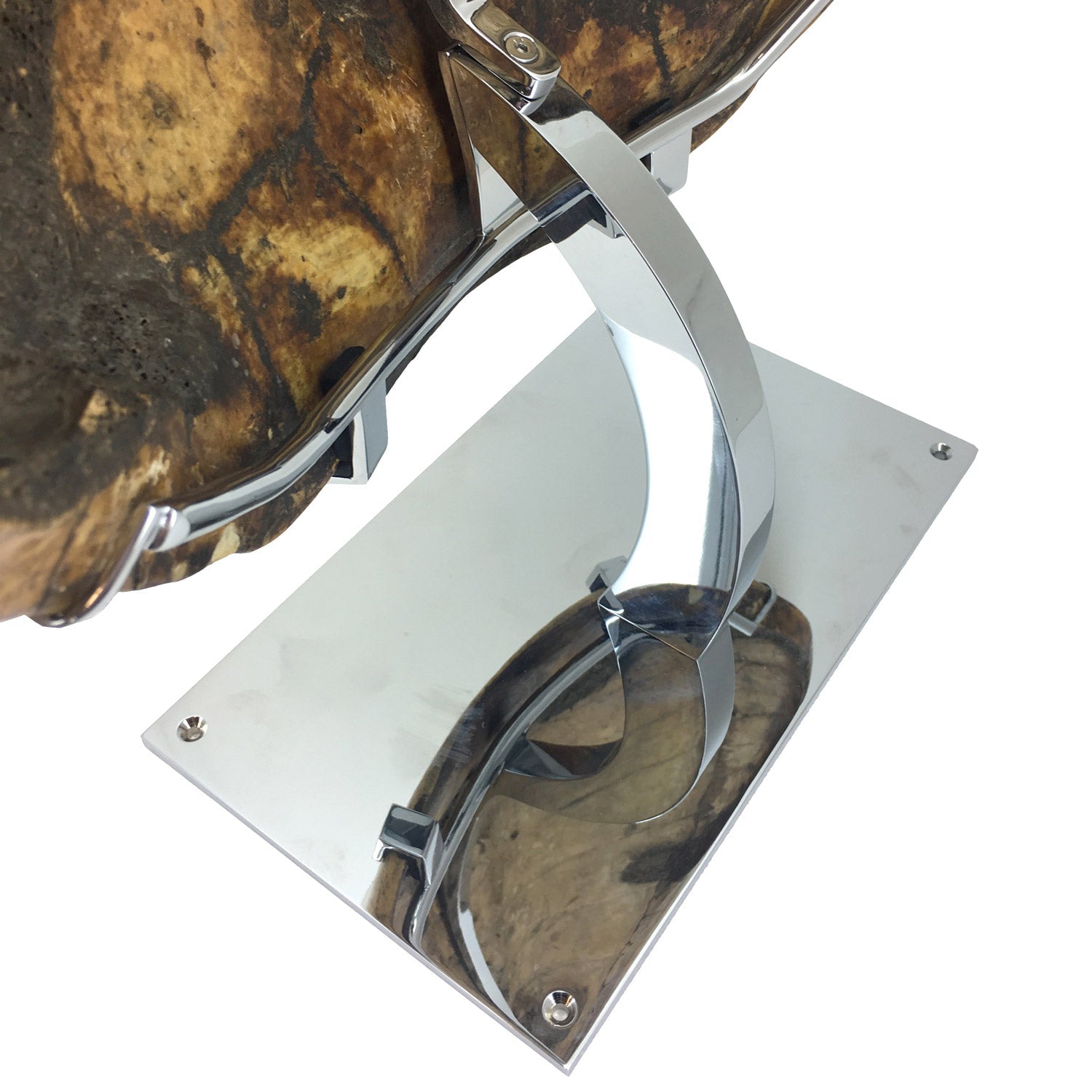
Prestige Base - The custom-made chrome-plated brass base
The Bubble and the Reunion of the National Museums-Grand Palais
